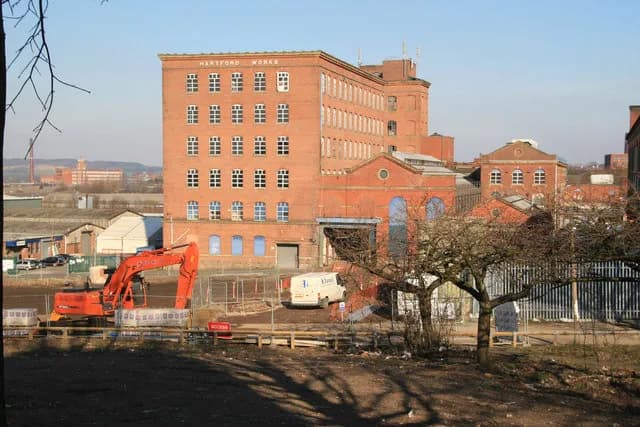
In 1929, a transaction took place between an Oldham textile machinery giant and a Japanese inventor that would eventually fuel the creation of the world's largest car manufacturer. Platt Brothers of Werneth paid £100,000 for the patent rights to an automatic loom designed by Sakichi Toyoda, providing the capital that launched the Toyota Motor Corporation.
The Powerhouse of Werneth
Platt Brothers traced its origins to 1770, when Henry Platt began manufacturing carding equipment in Dobcross, Saddleworth. The company moved to Oldham in 1820 and established its headquarters at Hartford New Works in Werneth in 1844. By the late nineteenth century, Platt Brothers had become the world's largest manufacturer of textile machinery.
At its peak during the 1890s and 1910s, the firm employed 15,000 workers across its Hartford Works, which covered between 65 and 85 acres. The company's economic significance to Oldham was substantial: according to historical records, Platt Brothers supported 42 per cent of the town's population during this period.
The "Magic Loom"
Sakichi Toyoda, born in Japan in 1867, had spent decades developing automatic weaving technology. In 1924, he completed the Toyoda Model G Automatic Loom, a machine so advanced that engineers from Platt Brothers reportedly referred to it as "the magic loom".
The Model G incorporated several groundbreaking features. It included a non-stop shuttle-change mechanism and mechanical sensors that automatically shut down the loom if a warp thread snapped. This principle, which Toyoda called jidoka ("automation with a human touch"), allowed one worker to operate up to 30 machines simultaneously. The productivity gains were significant, offering a twenty-fold increase over previous methods.
The 1929 Agreement
On 18 November 1926, Toyoda founded Toyoda Automatic Loom Works, Ltd. Three years later, in 1929, Platt Brothers negotiated a patent rights transfer agreement with the Japanese company. The deal cost Platt Brothers £100,000 and granted them production and marketing rights for the Type G automatic loom in all countries except Japan, China, and the United States.
This transaction provided Toyoda Automatic Loom Works with substantial capital. Historical records indicate that the proceeds from this sale became the starting capital for automobile development by the Toyoda family.
From Textiles to Automobiles
Sakichi Toyoda's son, Kiichiro Toyoda, established an Automobile Division within Toyoda Automatic Loom Works on 1 September 1933. The division produced its first prototype engine, the Type A, by 25 September 1934. The first production model, a truck designated G1, rolled off the line on 25 August 1935.
Toyota Motor Co., Ltd. was formally incorporated on 28 August 1937. The company's name change from "Toyoda" to "Toyota" in 1936 was driven by phonetic considerations: the name "Toyota" requires eight brush strokes to write in Japanese, a number considered lucky, and the change eliminated the voiced consonant that characterised the family name.
A Lasting Legacy
The principles Sakichi Toyoda developed for his looms, particularly jidoka, became foundational to the Toyota Production System. The concept of building quality into the manufacturing process, stopping production when defects are detected, and empowering workers to solve problems, all originated in Toyoda's textile machinery innovations.
Sakichi Toyoda died on 30 October 1930, less than a year after the Platt Brothers deal was concluded. He did not live to see the automobile company that bore his family's name, but his engineering philosophy continued to shape it.
Platt Brothers continued operating from its Werneth base until 1982, when the company closed. The firm's 1929 decision to purchase Toyoda's loom patents represented a chapter in Oldham's industrial history that reached far beyond Lancashire, providing the financial foundation for what would become one of the world's most influential automotive manufacturers.