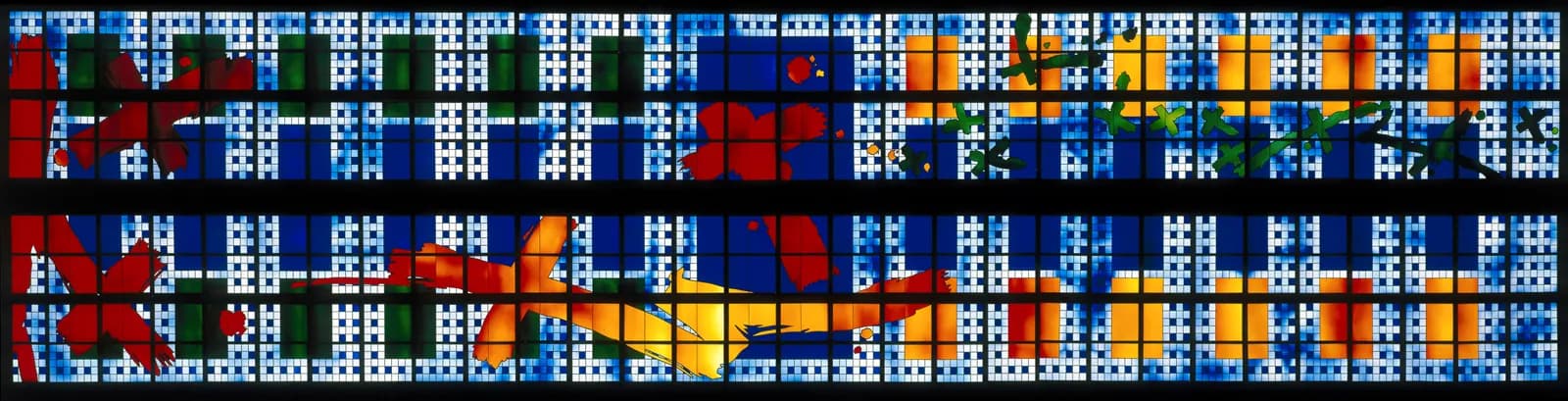
Tucked away inside the Spindles Town Square Shopping Centre lies one of Oldham's most remarkable cultural treasures: a suite of three monumental stained glass windows designed by internationally acclaimed artist Brian Clarke, created to honour the music of fellow Oldham-born composer Sir William Walton.
The Spindles Connection
The shopping centre's name itself evokes Oldham's industrial heritage, referencing the cotton spindles that once drove the town's economy. When the centre underwent development in the early 1990s, the opportunity arose to embed genuine cultural significance within this everyday commercial space. The result was a commission that would unite two of Oldham's most distinguished artistic figures.
Brian Clarke, born in Oldham in 1953, had already established himself as one of the world's foremost stained glass artists by the time he received the commission between 1990 and 1993. His work bridges contemporary art and architectural design, with pieces held in collections from the Victoria and Albert Museum to the Metropolitan Museum of Art in New York.
A Musical Tribute
The centrepiece of the installation is a 120-square-metre stained glass rooflight situated in the Small Mall, inspired by Walton's 'Orb and Sceptre' March. This composition, written for the coronation of Queen Elizabeth II in 1953, provides the visual vocabulary for the abstract design. Two additional interrelated windows complete the suite, creating a cohesive artistic statement that transforms the shopping centre's interior.
Sir William Walton, though often associated with the wider classical music world, was born in Oldham in 1902. His musical legacy includes the ceremonial march that inspired Clarke's work, alongside compositions such as 'Façade' and the Viola Concerto. The stained glass installation represents a rare instance of visual art directly responding to his musical output within his birthplace.
Architectural Integration
The windows demonstrate Clarke's approach to stained glass as an architectural medium rather than mere decoration. The rooflight filters natural daylight into the shopping centre's interior, casting coloured illumination that changes throughout the day. This dynamic quality transforms the commercial space into something approaching a secular cathedral, where visitors encounter contemporary art as part of their daily routine.
The choice of abstract forms rather than figurative imagery allows the windows to function on multiple levels: as a visual translation of musical rhythm and harmony, as a meditation on colour and light, and as a landmark within the town centre that distinguishes Oldham from comparable shopping destinations.
Local Heritage in Everyday Spaces
The Spindles installation exemplifies a particular approach to public art that embeds cultural value within functional architecture. Rather than existing as a separate attraction requiring special visitation, the windows form part of the fabric of local life. Residents encounter them while running errands, meeting friends, or passing through the town centre.
This accessibility aligns with Oldham's history of making art available to working communities. The town's substantial investment in public culture, from the Gallery Oldham collection to the Oldham Coliseum Theatre, continues a tradition that recognises artistic engagement as integral to civic life rather than an elite pursuit.
Preservation and Recognition
As the Spindles centre approaches its fourth decade, the stained glass windows remain among Clarke's most significant permanent public commissions in the United Kingdom. Their condition and continued display represents both a maintenance responsibility for the centre's management and a cultural asset for the town.
For visitors and residents alike, the windows offer a moment of unexpected aesthetic encounter within an otherwise familiar environment. The connection they establish between Oldham's industrial past, its musical heritage through Walton, and its continuing contribution to contemporary art through Clarke's practice creates a layered narrative of local identity.
The installation stands as evidence that significant cultural production need not be confined to dedicated museums or galleries, but can inhabit and transform the spaces where communities actually gather.