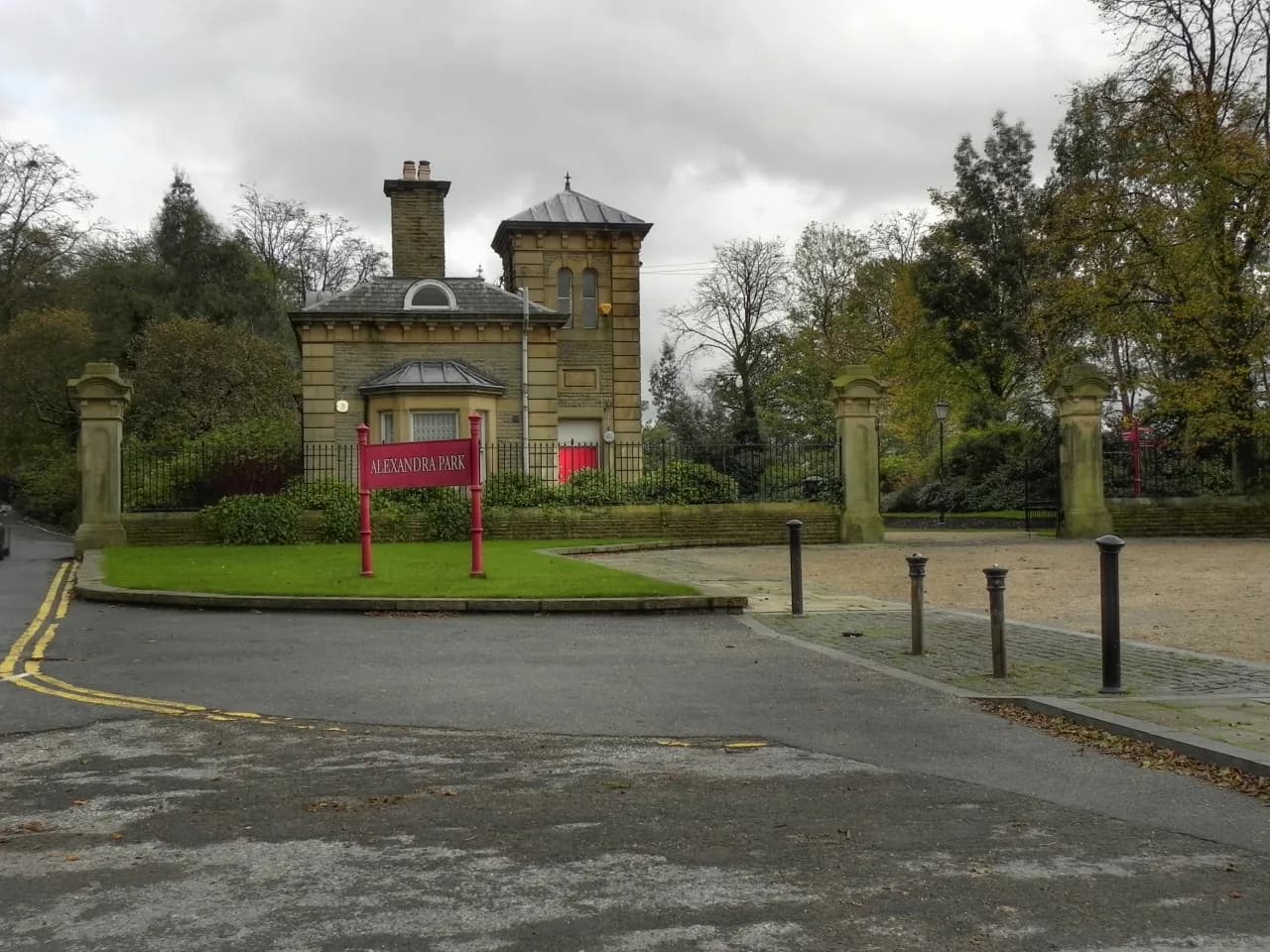
In the Glodwick district of Oldham stands a 23-hectare park that represents one of the most significant civic responses to the Lancashire Cotton Famine of the 1860s. Alexandra Park, opened in August 1865, was constructed specifically to provide employment for cotton operatives left without work when the American Civil War disrupted raw cotton supplies to Lancashire's mills.
Origins During Crisis
The Lancashire Cotton Famine, which lasted from 1861 to 1865, devastated Oldham's economy. The town was wholly reliant upon textile processing, and when Confederate blockades prevented American cotton from reaching British shores, mills closed and thousands lost their livelihoods. The crisis coincided with an existing overproduction problem in the cotton industry, compounding the economic hardship.
The solution came in the form of the Public Works (Manufacturing Districts) Act 1864, which permitted local authorities to borrow money for public works projects that would employ those affected by the famine. A committee formed in 1863 to create a new municipal park for Oldham, taking advantage of government loans offered at 3.5 per cent interest.
A Condition of Employment
The land for Alexandra Park was purchased from Reverend John Thomas Cocker of Shaw and Crompton, whose family had held the Swine Clough Estate for over three centuries. The purchase price was £10,750, but Cocker attached a crucial condition: the sale would proceed only if local unemployed cotton workers were employed to carry out the necessary construction work.
This stipulation ensured that the park would serve not merely as a recreational amenity but as direct relief for those suffering economic hardship. The land acquisition ultimately cost £18,000, with the total project including buildings, roads, and the culverting of Sheepwash Brook reaching approximately £31,000.
Victorian Design and Craftsmanship
The park's design was entrusted to William Henderson, who had previously worked on Birkenhead Park. A second design competition was also adopted from Messrs Woodhouse and Potts of Oldham. Construction began in 1863 and continued through the famine years, with work completing in 1865.
The resulting park demonstrates characteristic Victorian park design principles. The Top Promenade offers a terrace walk approximately 300 metres long and 14 metres wide, lined with an avenue of black poplars. Notable architectural features include two entrance lodges: the main entrance lodge, built of sandstone in Italianate style by Woodhouse and Potts in 1863, and Glodwick Lodge. These structures, along with the conservatory supplied by Messengers in 1907, the pagoda-style observatory dating from 1899, and several statues and fountains, are all Grade II listed.
The park also contains several commemorative monuments, including a bronze statue of John Platt MP dated 1878 by D W Stevenson of Edinburgh, a granite and bronze statue of Robert Ascroft erected in 1903 by E W Pomeroy, and a statue of Joseph Howarth erected in 1868 by public subscription.
Opening and Naming
Alexandra Park was officially opened on 28 August 1865 by Josiah M Radcliffe, then Mayor of Oldham. The park took its name from Princess Alexandra of Denmark, who had married Albert, Prince of Wales, on 10 March 1863. The timing connected this new civic space to royal celebration while acknowledging the difficult circumstances of its creation.
A blue plaque within the park commemorates its origins as a Cotton Famine public works project, serving as a permanent reminder of the connection between Victorian civic infrastructure and social welfare.
Heritage Recognition and Restoration
Alexandra Park was designated a Grade II* registered park in 1995, recognising its exceptional historical significance. The designation reflects not only the quality of its Victorian design, which remains essentially unchanged from its original 1860s layout, but also its importance as an early example of municipal park provision and public works employment schemes.
Following decades of gradual decline, the park underwent significant restoration funded by the Heritage Lottery Fund, reopening in 2004. The Lion's Den, a stone plinth with seating area that originally featured an arcaded shelter, was rebuilt and restored in 2002. The statues known as Emma ("The Flower Girl") and Rebecca at the Well were also renewed and replaced in 2002.
The Park Today
Contemporary Alexandra Park offers facilities including a heated conservatory, a boating lake with a fishing club and half-timbered boathouse containing a cafe, seven free tennis courts, three crown green bowling greens, and a children's play area equipped with accessible features including sensory paths, a hammock swing, and a wobble bridge with wheelchair accessibility. A woodland walk runs adjacent to Queen's Road.
The Alexandra Park Hub, opened in 2013, operates as a community food growing project providing training and demonstration opportunities for local residents. This initiative continues the park's tradition of serving community needs, echoing the original employment scheme that brought the park into existence.
Legacy of the Cotton Famine
Alexandra Park stands as a physical reminder of how the Lancashire Cotton Famine reshaped civic infrastructure across the region. The Public Works (Manufacturing Districts) Act 1864 enabled numerous similar projects throughout Lancashire, but Alexandra Park remains one of the most significant surviving examples.
The park represents a Victorian approach to economic crisis: using public investment in lasting civic amenities to provide immediate employment relief. The condition imposed by Reverend Cocker, that unemployed cotton workers must build the park, ensured that the beneficiaries of this public work were those most affected by the economic catastrophe.
Future plans for the park include a proposed £7 million Alexandra Park Eco Centre, intended to be carbon neutral with minimal running costs. This facility would serve as an anchor development for the Northern Roots Project, which aims to create the UK's largest urban farm and eco-park on the neighbouring 160-acre Snipe Clough site.
From its origins as famine relief employment to its current role as a community resource and heritage site, Alexandra Park demonstrates how Victorian civic vision created lasting public goods that continue to serve Oldham residents more than 150 years after the cotton workers completed their work.